
San Juan County Deed Records
A deed moves land from a grantor to a grantee. Other instruments affect the file too. The Recorder indexes them all. A probate transfer may carry an executor's or administrator's signature. A beneficiary deed, by contrast, shapes what happens at death. Mortgages and deeds of trust create a secured claim. They do not create a new owner of record. A release or reconveyance should follow once the loan is paid. Read any deed result in that context.
| Instrument type | What it records | Why it appears in a parcel file |
|---|---|---|
| Conveyance deed | Transfer from grantor to grantee | Shows a recorded change in interest |
| Executor or administrator deed | Transfer signed by a personal representative | Can follow a probate appointment or order |
| Beneficiary deed | Transfer instrument tied to a named beneficiary | May explain a later death-related conveyance |
| Mortgage or deed of trust | Security interest in the property | Shows a lien, not an owner change |
| Release, satisfaction, or reconveyance | Later instrument clearing a recorded claim | Confirms a separate release was filed |
| Easement or plat | Use rights or a mapped subdivision record | May burden or describe the parcel |
The Recorder's index gathers official instruments. No single entry settles a title question. Pull the document image, read the legal description, and watch for a later release or amended plat where it matters.
San Juan County Recorder Search Modes
Quick Search takes a grantor or grantee, subdivision, document type, or document number. It also allows a recorded-date range. Advanced Search narrows the Department to Real Property. It then splits Party Names, Grantor, Grantee, dates, document type, document number, book, volume, page, legal description, and full document text into separate fields. The office does not publish the exact document-type dropdown choices. Start with a party name. Use a legal description when you cannot tell which category the Recorder applied.
| Search field | Purpose | Useful detail |
|---|---|---|
| Party Names | Find a party in the index | Enter LASTNAME FIRSTNAME, then press Enter |
| Grantor / Grantee | Search transfer sides separately | Useful for backward chain work |
| Recorded date range | Limit the results | MM/DD/YYYY fields |
| Document type / number | Filter or find a known instrument | Exact type list not captured |
| Book, volume, page | Follow a cited record location | Use values from an older reference |
| Legal description | Search parcel text | Try lot, block, subdivision, or tract |
| Full Document Text (OCR) | Search recognized scan text | Two or more words are treated as a phrase |
The official Advanced Search form shows these separate fields.
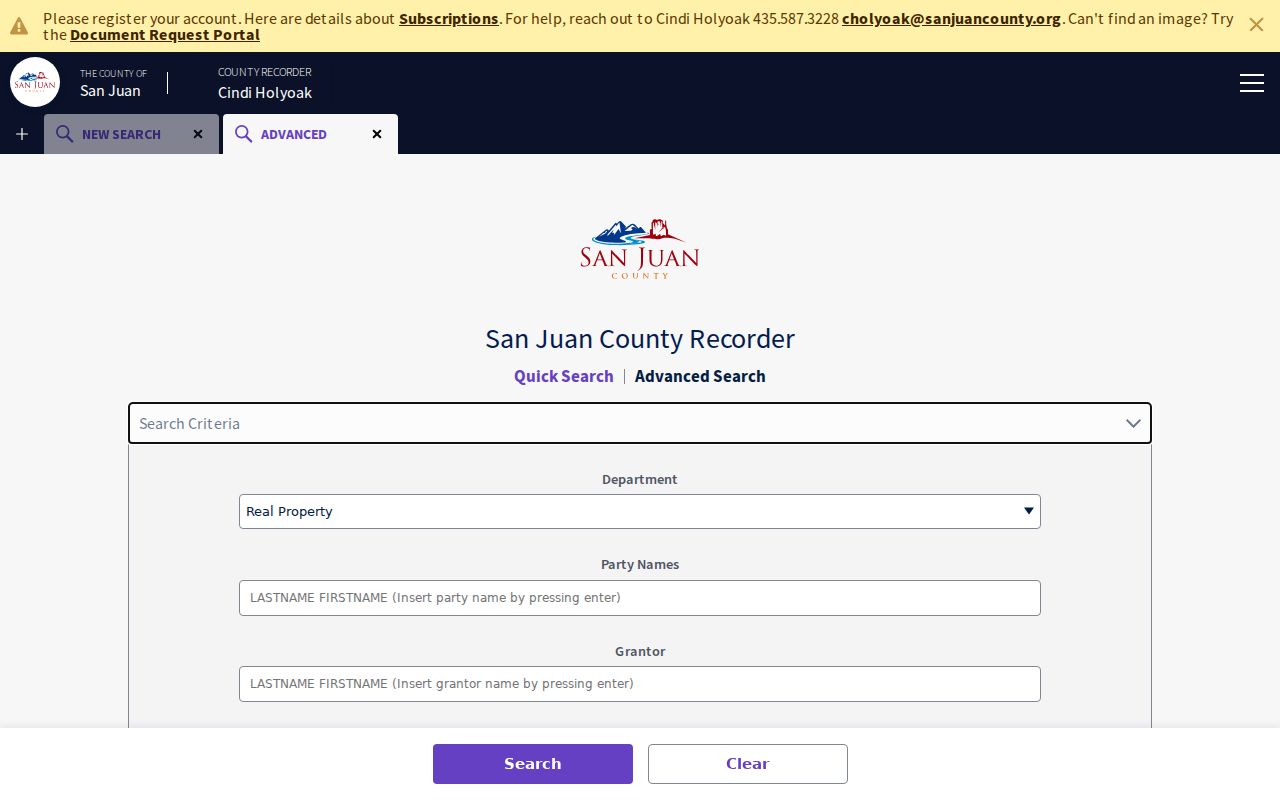
Match the field to the evidence you hold. A parcel address is not guaranteed to appear in the deed index.
San Juan County Index and OCR
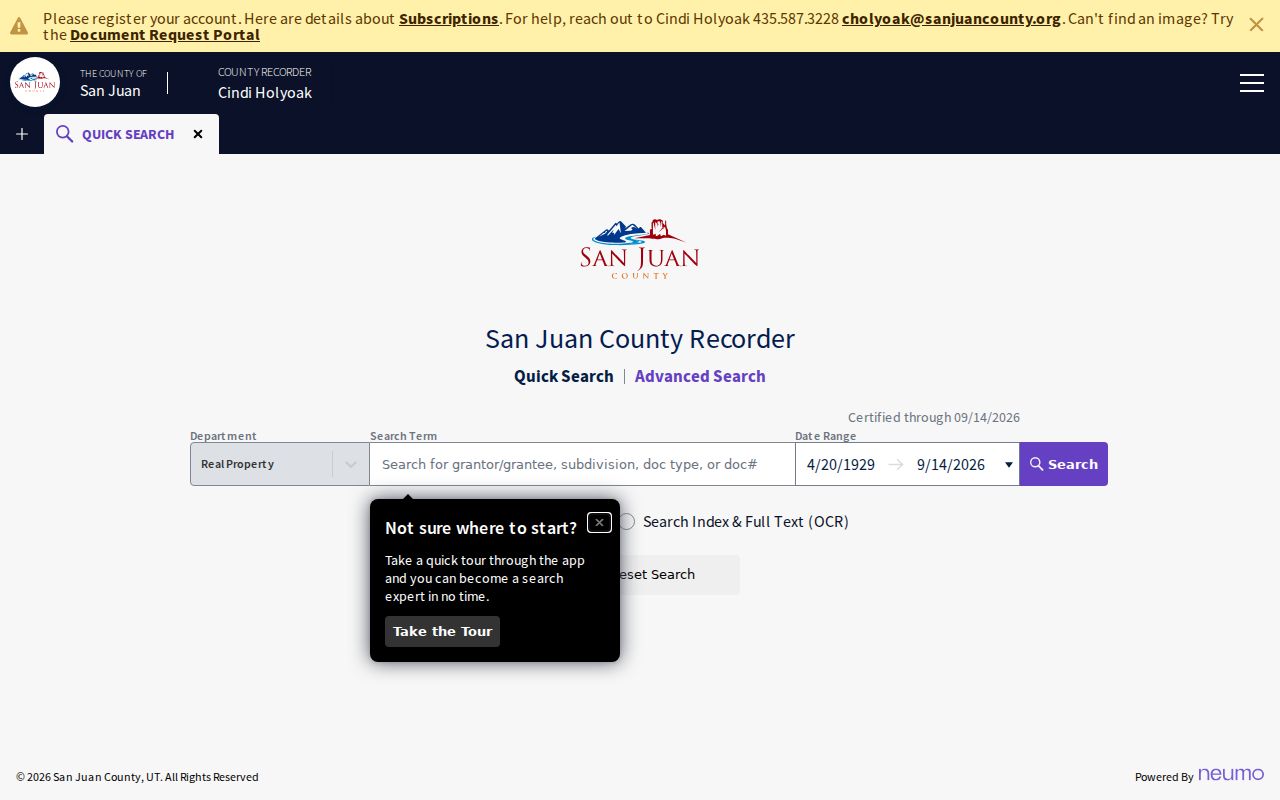
The Recorder's quick form offers two modes. Index-only checks each word on its own, while full-text OCR treats two or more words as a phrase. A phrase query can return nothing. A word-by-word search would find the entry in that case. Run separate searches for each party, and try a subdivision or legal-description term the same way. OCR text carries recognition errors, so confirm any apparent match in the page image.
The certification date shown on the portal marks a certification point only. It does not date every indexed record. The online starting year goes unstated. The Recorder keeps its physical land collection from the late 1800s to the present.
The San Juan County quick-search page lists date shortcuts. It also shows the scope choices.
Treat a result as a starting point. It is not a title opinion, and it does not prove a lien has been released.
Following the San Juan County Deed Chain
Find the current recorded deed first. Note its grantor, grantee, legal description, reception number, and book/page reference. The grantor gives up the interest. The grantee takes it. Search that grantor as a prior grantee, then compare the next deed's legal description against the tract you started with. Names change at a death, replat, trust transfer, or entity conversion, so the land description often gives the stronger link.
- Search the latest grantee or known owner in the Recorder index.
- Open the conveyance and record the grantor, date, instrument reference, and legal description.
- Search the grantor as grantee to locate the earlier acquisition, checking the description each time.
- When the online result ends, ask the Recorder which earlier book or index to consult.
- Grantor
- The party named as transferring an interest.
- Grantee
- The party receiving the recorded interest.
- Chain of title
- The linked sequence of recorded transfers for a tract.
- Reception number
- The county’s instrument reference; book and page can also locate a record.
The full backward timeline belongs on the San Juan County former-owner record route.
San Juan County Historical Deed Books
Utah Archives calls the San Juan County Recorder's records permanent. The same series includes permanent grantor mortgage indexes and abstract books organized by tract or geographic location. It also holds fee and entry books preserving names, instrument type, entry number, and book/page. A catalog note dates combined and separate registration to 1949. Treat it as a format clue. Earlier records may still exist, and the online index need not begin there.
A pre-digital search goes better with preparation. Bring the parcel number and known owners. Bring the legal description, subdivision or lot and block, township and range when available. Also bring any reception or book/page citations. Recorder staff may help you get started. They cannot perform the full search. You should ask whether the index you need is scanned, microfilmed, or counter-only.
Utah Archives and FamilySearch catalogs can add historical context. Marriott Library, BYU Special Collections, and local libraries can too. Each collection's images and date span need checking. Start with the Recorder's historical-record information and the state Archives record-series directory.
Requesting a San Juan County Deed
San Juan County offers a Property Document/Information Request Portal for help with a specific instrument. The Recorder takes cash, check, or electronic payment. For the electronic option, call the office for a total. Staff will email a payment link. The county publishes no exact copy-price schedule. Utah's 2026 HB-38 notice raised recording fees for documents, subdivision plats, and redactions by $5 on May 6, 2026. Copy fees and recording fees are separate charges. Confirm the current schedule before quoting any amount.
Visit in person at 117 South Main, Room 103, Monticello. You can also mail a request to P.O. Box 789. Public hours run Monday through Friday, 8 a.m. to 5 p.m. Electronic recording hours vary by day. A telephone request can yield a parcel ID, current ownership, acreage, or limited recording details. The office will not read metes-and-bounds dimensions over the phone.
When a deed image is missing, request the instrument by reception number, grantor and grantee, and recording date. If the index stops short of the period you need, cite the book or date range directly. That saves staff from tracing the whole chain of title by hand.
San Juan County Releases and Liens
A lien does not vanish from the public record once the debt is paid. San Juan County deed records show the debt and, separately, the paper that cleared it. Look for a recorded release, satisfaction, reconveyance, or discharge. You may also find a court order tied to the same parcel. Search by party name. Search by legal description too. Cover deeds of trust, mortgages, assignments, mechanic's liens, judgment liens, tax liens, easements, rights-of-way, covenants, and restrictions.
A lien enforcement case may also surface in Utah Courts Xchange. The Recorder index, meanwhile, holds any recorded notice in that dispute. A parcel may border a road, canal, river, or shared access. Read the easement and plat instruments alongside the deed itself. A court docket naming land does not establish current title. A Recorder image will not reveal every pending lawsuit or unrecorded equitable claim. A judgment may touch the parcel. If so, check the case file. Also check any later instrument filed with the Recorder.
San Juan County Property Alert
The Recorder portal includes a Property Alert feature. The county publishes no detailed terms on the page itself. So confirm a few basics before relying on it. Ask the office whether signup is free. Ask which names or parcels the service monitors. Ask which document types trigger a notice. And ask how alerts arrive. A portal link alone does not mean every parcel or instrument is covered.
Use the county Recorder page to verify the official signup address. Contact the office if the flow seems unclear. An alert can flag a new filing quickly. But it cannot stop a document from being recorded. It also never replaces reading the instrument itself. See the Recorder's property alert destination and check current terms with the county.
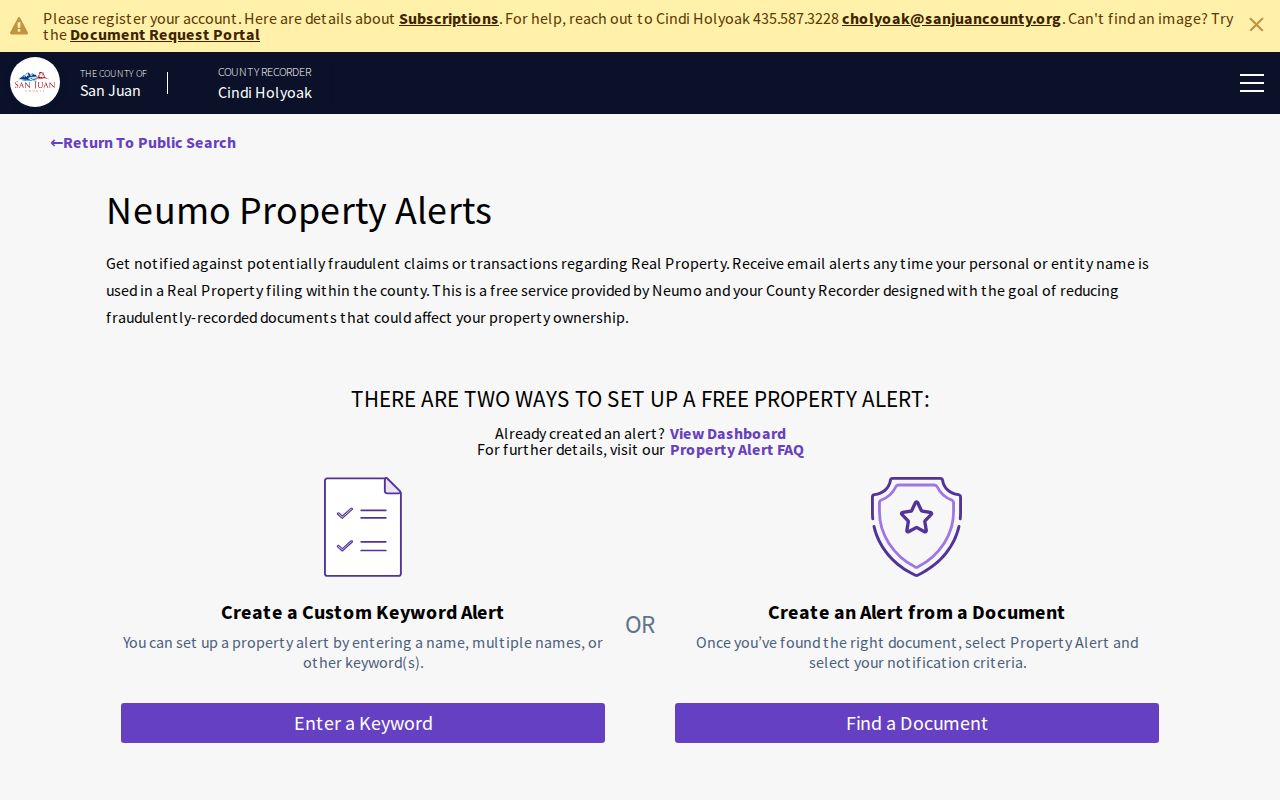
Note: Treat the alert as a nudge to check the record, not as title insurance or legal advice.
What San Juan County Deed Records Prove
Deed records prove only that an instrument was accepted for recording. They do not prove every interest is clear. They do not rule out an unrecorded claim. They cannot fix a parcel line on the ground. Confirm the instrument, any later releases, the legal description, and the plat before drawing conclusions. A title company or attorney can render a title opinion. A licensed surveyor settles a boundary question.
Recorded, not guaranteed. A San Juan County deed index shows recorded instruments and references. It is not a title commitment, survey, or guarantee of current ownership.